
Guardians of Memory: A Labor Day Tribute to Heritage Workers
A Day Born of Struggle
Every year on the first of May, the world pauses to honor those who labor, and more precisely, those who have fought for the dignity of their work. What is called now Labor Day traces its origins from an act of collective courage. In 1885, the American Federation of Labor resolved that May 1st, 1886 would mark the demand for the eight-hour day. What followed became a turning point in history: in May 1886, American workers took to the streets, and the violence of Haymarket Square inscribed their struggle into memory. Bringing us to 1889, Paris, where the Second International, a federation of socialist and labor parties, consecrated May Day as a universal symbol of solidarity.
On our side of the globe, Lebanon aligned early with the international labor movement, with Labor Day first recognized in 1925 under the French Mandate and later formalized by a law issued on 30 April 1959, under President Fouad Chehab, establishing May 1st as an official public holiday. This law grants employees a paid day of rest, while ensuring that those required to work receive appropriate compensation. Adopted during a period of institutional consolidation, this law embeds labor protections within national legislation and reflects Lebanon’s integration into broader global efforts advocating for workers’ rights, fair wages, and social safeguards.
What began as a demand for time became a global commitment: the recognition that labor, any labor, carries inherent dignity, deserves fair conditions, and must be protected by collective will. On May Day 2026, ICOMOS Lebanon extends this commitment to those whose essential work often remains unacknowledged: the professionals devoted to safeguarding cultural heritage. Their labor, though quiet, sustains the memory and identity of humanity, and stands as a testament to the enduring link between work, dignity, and solidarity.
Heritage as Labor
It is tempting to think of heritage professionals as custodians of the past, set apart from the ordinary world of work. But conservation, restoration, documentation, archaeology, and heritage management are, above all, labor—the skilled, specialized, and physically demanding type of labor that is too often undervalued.
It is true that cultural heritage is a lucrative asset and a major industry, generating millions of jobs and billions of dollars in revenue each year, and contributing to substantial portions of national GDPs. Yet despite these tremendous economic and socio-cultural benefits, little attention is usually paid to its conservation, especially for smaller sites with limited visibility but equal importance, or to developing innovative strategies that could modernize the professional field. This paradox, manifested in heritage being celebrated in tourism brochures while neglected in professional investment, sits at the heart of what it means to labor in this sector.
The academic literature on creative and heritage labor has long pointed to a structural invisibility. Artistic and creative work is often considered an intangible cultural asset, and hence the contribution of creative workers is frequently overlooked in policy frameworks. The same applies, by extension, to conservators, restorers, archivists, and site managers, whose technical and intellectual output is rarely quantified in the terms that attract institutional recognition. This leads to heritage archivists reporting careers marked by short-term contracts, facing a lack of standardized practices that often results in inequitable workloads, limited professional development opportunities, and chronic instability for workers.
This means that what we are facing here is not a peripheral issue, but a structural one, as it touches upon the systemic underfunding of the very people entrusted with humanity’s most irreplaceable assets.
Workers Like No Other
What distinguishes heritage labor from most other professions is not merely its subject matter, but the irreversibility of failure. A conservator who loses a fresco to neglect, bombardment, or inadequate resources cannot restore what is gone. The stakes are permanent, creating a particular form of professional responsibility and a particular form of occupational burden.
Beyond professional precarity, there are the physical conditions of the work itself: the solvents, the dust, the confined spaces of vaults and excavation sites, the long hours of close technical attention. And beyond the physical, there is the ethical weight of stewardship, knowing that what passes through your hands passes to future generations. A thought that accompanies heritage workers as they do not merely preserve objects, but rather preserve the continuity of human identity.
This is precisely what the Faro Convention recognized in 2005, when it reframed cultural heritage not as a collection of monuments, but as a living relationship between communities and their memory. The Faro Convention establishes rights and responsibilities to and for cultural heritage, explicitly in the context of Article 27 of the United Nations Declaration of Human Rights, which guarantees the right to freely participate in the cultural life of the community. If access to heritage is a human right, then those who make that right possible, that is, the heritage workers, are exercising a function as fundamental as any in civil society.
Laboring Under Fire
Nowhere is the weight of heritage labor heavier than in zones of conflict. When war comes, cultural heritage becomes both a casualty and a battleground, rendering the professionals who refuse to abandon it something closer to first responders rather than curators.
The texts on heritage protection in armed conflict make clear the magnitude of what is at stake. In times of war, cultural heritage is often viewed as a tragic casualty. Emergency plans for safeguarding cultural heritage have enabled cultural workers to safely evacuate museum collections. ICCROM’s First Aid to Cultural Heritage in Times of Crisis handbook has offered a comprehensive guide for cultural workers seeking to improve emergency plans within their institutions, and numerous studies have shown that such times require not money so much as knowledge, political will, and sufficient time to implement them. Time, however, is precisely what conflict denies.
Lebanon knows this reality intimately. The 2024 and 2026 Israeli wars on Lebanon damaged or destroyed numerous cultural heritage sites. The destruction was concentrated in southern Lebanon, among other areas, with entire historic villages reduced to rubble. Subsequently, UNESCO granted enhanced protection to 34 heritage sites in 2024 and later 39 in 2026. In March 2026, ICOMOS International deplored the lives lost and expressed grave concern over the critical threat to Lebanon’s cultural heritage, as both National and World Heritage sites were endangered. Reports of damage continued to emerge, with rockets striking in the immediate vicinity of World Heritage properties, historic churches and mosques, castles, and historic Souks. Therefore, ICOMOS International strongly condemned the destruction of the living fabric of towns and rural settlements, as well as the large-scale displacement of populations whose very presence gives life to heritage, as displacement has dramatic repercussions on intangible cultural heritage.
And yet, even in these circumstances, one should acknowledge something remarkable: the engagement of volunteers and experts despite the dramatic conditions. Those words, volunteer and expert engagement despite the dramatic circumstances, deserve to be read slowly as they describe professionals and committed citizens who, with no guarantee of personal safety, no certainty of institutional support, and no clear end in sight, continued to document, to protect, to bear witness. That is labor. That is vocation. That is an act of courage that no job description fully captures.
A Tribute
On this Labor Day, ICOMOS Lebanon salutes all heritage workers, the architects and archaeologists, the conservators and restorers, the archivists and museum professionals, the researchers and community volunteers, the site guards and the documentarians, across Lebanon and across the world.
We salute those who work in the quiet of laboratories and storerooms, under fluorescent light, with instruments of extraordinary delicacy, on materials of extraordinary fragility.
We salute those who work in the field, in sun and dust and mud, on excavations and surveys, in dialogue with communities whose connection to place is the very thing being protected.
We salute those in the archives and libraries who ensure that the documentary memory of civilizations is not lost to time, neglect, or institutional indifference.
And above all, on this day, we salute those who continue to work under conditions that no professional should ever have to face: in the shadow of bombardment, amid displacement and loss, in towns and villages where the line between safeguarding heritage and simply surviving has become impossibly thin. The men and women of Lebanon’s heritage community, at the Directorate General of Antiquities, at universities, at civil society organizations, in local municipalities, on the ground in the south and the Beqaa, who, even at the height of conflict, documented what was damaged and protected what could still be protected.
Their commitment is not naive. It is a form of clarity: the understanding that when everything else is destroyed, it is memory that sustains a people; that preserving a castle, bell tower, minaret, a souk, a mosaic floor, a traditional craft, is not secondary to survival, but a part of survival.
Preservation as an Act of Resistance
May Day has always been, at its core, a refusal: the refusal to accept that labor is a commodity, that workers are expendable, that dignity is a privilege. Heritage workers in conflict zones enact their own form of that refusal every day; the refusal to let violence have the last word; the refusal to allow that what was built over millennia be erased in hours without record, without mourning, without a fight.
Culture finds itself, once again, on war’s frontline. The heritage sector, the military, and other stakeholders in human security must collaborate to give primacy to people and protect cultural heritage under attack, drawing on lessons from past conflicts to safeguard what remains.
We at ICOMOS Lebanon believe that heritage work is, in the deepest sense, an act of solidarity with the past and with the future. It says: we were here, we built something, and it mattered. On this Labor Day, we honor those who carry that message forward, under every condition, at every cost.
To all heritage workers in Lebanon and beyond: your labor is seen. Your commitment is honored. Your courage is not forgotten.
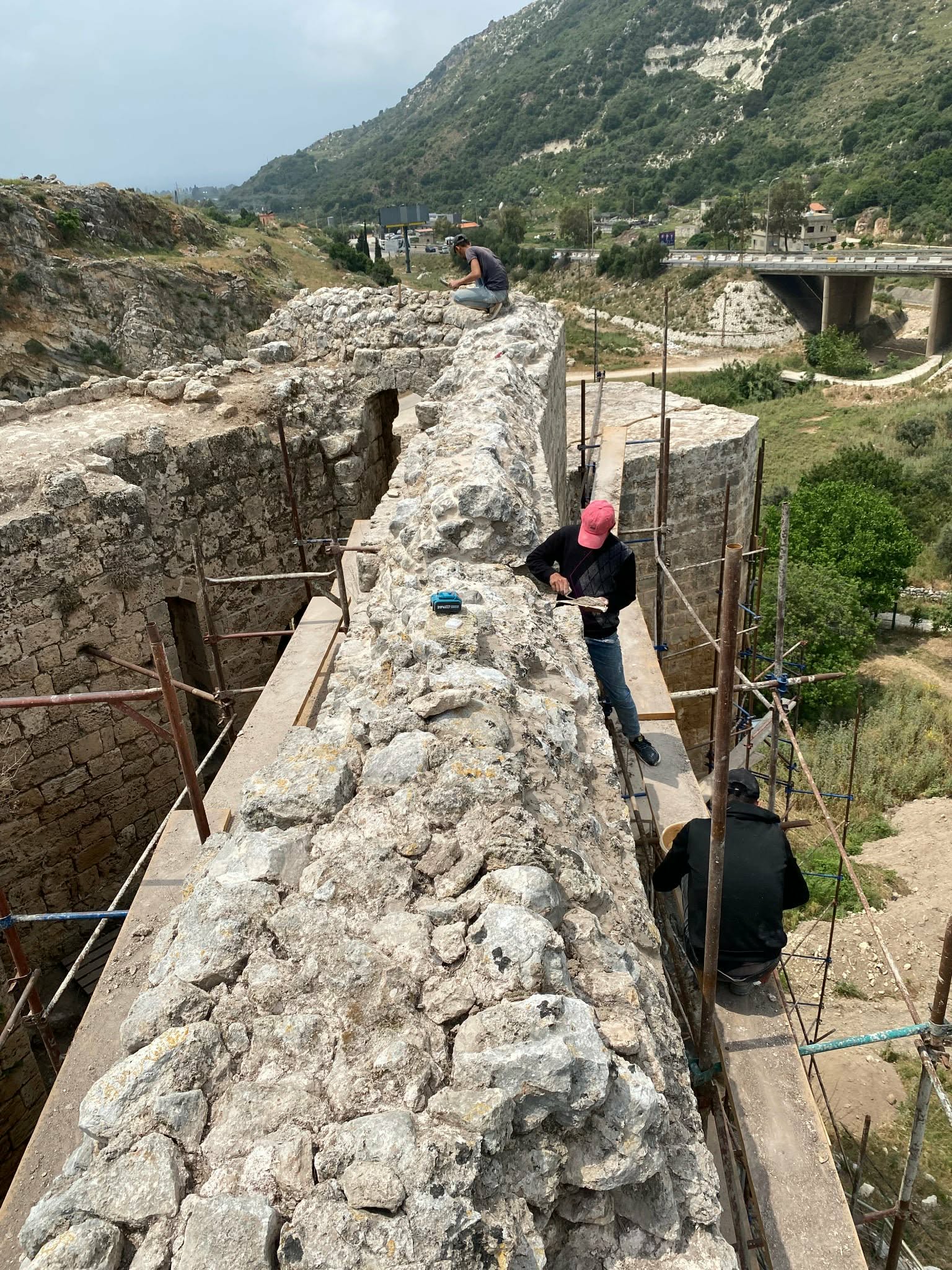
Photo credit: © Maroun Hoshaymeh
Location: Mseilha Fort, Hamat – Lebanon