
Baalbek
Home to some of the best-preserved and grandest Roman temple ruins in the world, Baalbek is a testament to imperial Roman architecture.
Historical Significance
Known as Heliopolis in antiquity, Baalbek was one of the largest sanctuaries in the Roman Empire and a pilgrimage destination for thousands. The site’s religious importance predates the Romans — the Phoenicians venerated Baal here, and the Greeks identified it with Helios, the sun god. The Romans transformed it over two centuries into a monumental complex that rivaled anything in Rome itself. Its sheer scale was intended to project imperial power to the eastern provinces.
The Temple Complex
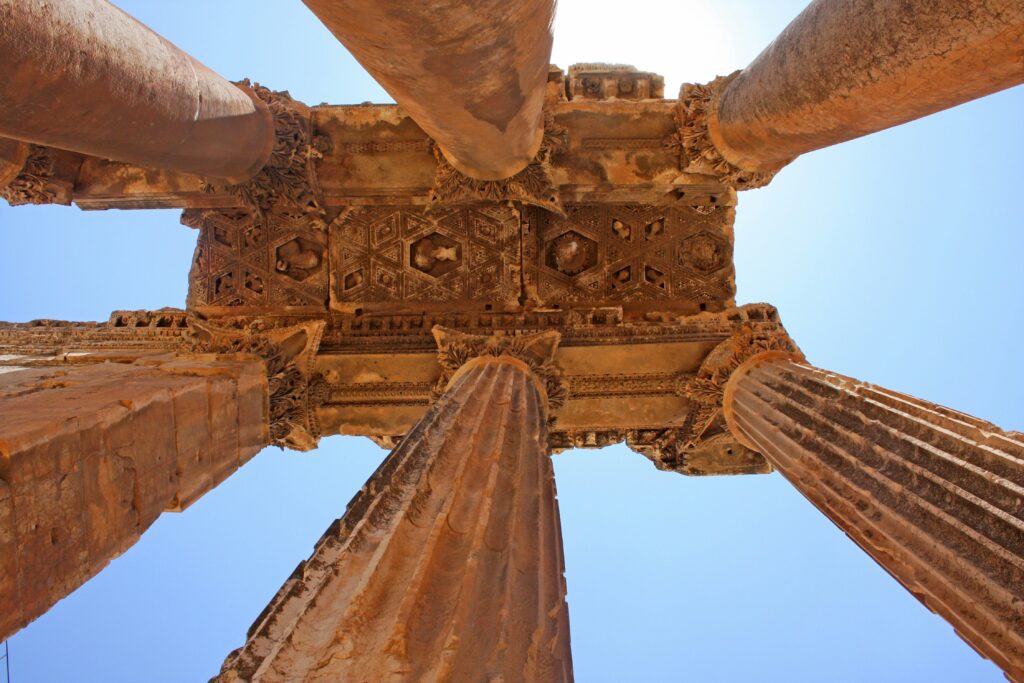
The Temple of Jupiter, originally surrounded by 54 colossal Corinthian columns (of which six still stand at 22 meters), remains one of the largest temples ever built. Adjacent stands the remarkably intact Temple of Bacchus, considered the best-preserved Roman temple of its size anywhere in the world. The circular Temple of Venus, with its graceful colonnade, showcases a more intimate architectural expression. The Trilithon — three massive stones weighing approximately 800 tons each — continues to fascinate engineers and archaeologists.
The Living Heritage
Baalbek is not merely an archaeological relic but a living cultural venue. The Baalbek International Festival, held annually among the temple ruins since 1956, has hosted legendary performers from Ella Fitzgerald to Fairuz, bridging ancient heritage with contemporary culture. This dual identity as both a monument and a stage makes Baalbek uniquely vital in Lebanon’s cultural landscape.
Quick Facts
- Region Bekaa Valley
- Period Phoenician / Roman
- Inscribed 1984
- Criteria (i)(iv)